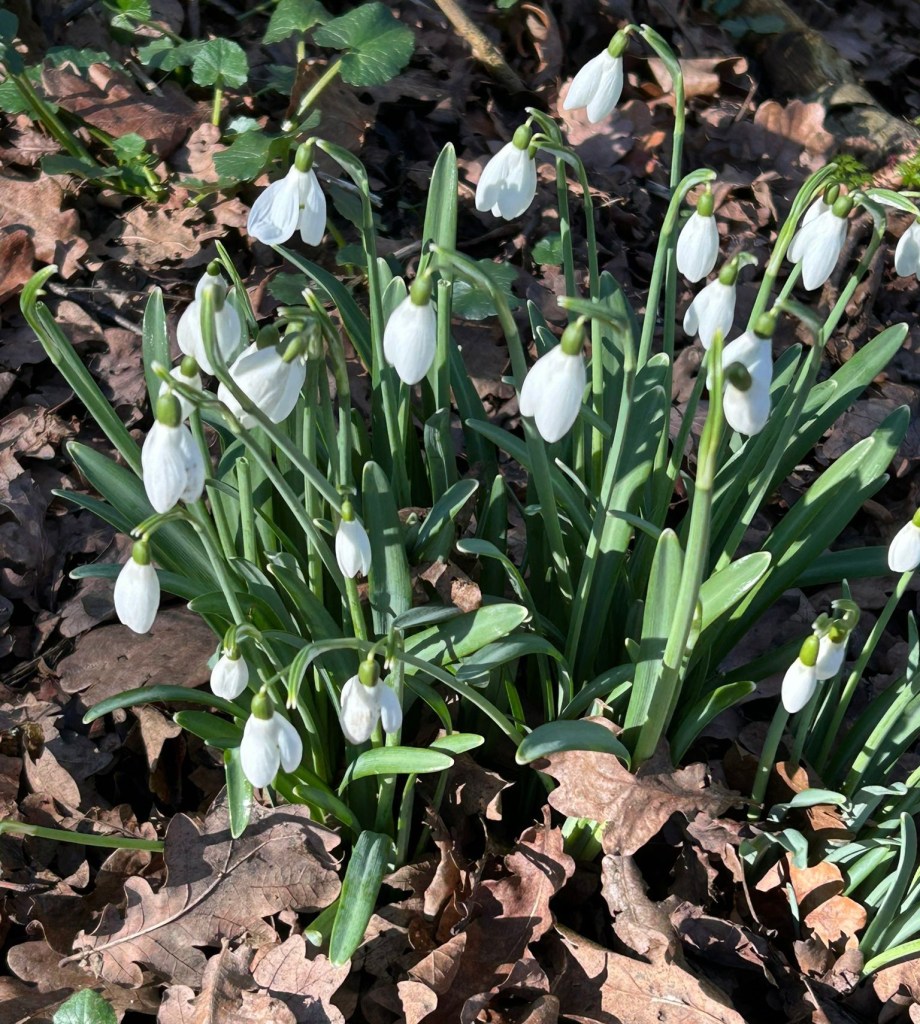
Sometimes I feel it acutely – a need to be in nature, away from the human-made world, surrounded by the sights and smells only nature can provide. The sound of the wind in the trees, birds singing, the feeling of soft soil underfoot, covered with dry and crispy leaves. Budding trees and the first flowers of spring: snowbells and crocus, celendine and coltsfoot. It’s all there, alive and always moving, changing.
This deep need to connect with nature can be explained by the biophilia hypothesis, that was introduced in 1984 by Edward O. Wilson, an American biologist, in his book Biophilia. The term biophilia refers to ‘an innate affinity for living systems, and the connections humans seek with nature for both survival and personal fulfilment’ (1). Since 1984, a lot of research has been done that confirms this hypothesis. We do not only have ‘an affinitiy for living systems’, we need the natural world for our survival, as well as for our physical and mental well-being.
It is sadly ironic that while we (re)discover the importance of the natural world for our mental and physical health, we are in the middle of the sixth wave of extinction – many species are on the brink of disappearing altogether, due to human causes. The clearing of natural areas for human use reduces wild spaces, and pollution and climate change do the rest.
This results in another form of extinction – the extinction of experience, a term coined by the author and ecologist Robert Pyle. The way we, or our children, experience nature is very different from how our parents or grandparents experienced it. In just the last 30 years, insect populations have reduced by 70%, resulting in clean windshields when driving in rural areas. That sounds like good news, but it also means a decline in numbers and species of birds and other animals. The area of flowering meadows has significantly reduced as well. Even I remember from my childhood fields full of wildflowers in summer. We would go and pick some to take inside the house – as there was plenty. Show me a place where you can do that now!
The problem is that every generation sees the world they grow up in as the norm, also called the shifting baseline syndrome. If you have never seen or experienced a field full of singing skylarks, you do not know what you are missing. If you see a butterfly or two, but you don’t know that there used to be ten or twenty times more in that same area, you are just happy to see the butterflies. If you notice them at all.
That just makes me sad. It is a sadness that can be described with the term solastalgia: ‘a feeling of nostalgia and powerlessness about a place that once brought solace, which has been destroyed’ (2).
Interestingly, you don’t even have to realise what you are missing to be affected by it. We all need a connection with nature, that is part of our humanity. We need other human beings in our lives, but also other-than-human beings. If we don’t have that, we will experience ‘species loneliness’ – a collective sorrow and anxiety rising from our disconnection from other species (2). We need a healthy relationship with the wider, natural world.
Back to my love for nature. It is a complicated relationship. I am looking for overwhelming and awe-inspiring experiences, to be immersed in the natural world, to be revived and restored by it. But where can I go to find this? How far away from home do I have to travel to be in a place where the footprints of humanity are not all around? And am I perhaps at least partly responsible for the destruction of nature in the first place?
But all is not lost. We may have to travel far to find wild places, but nature is everywhere – it is everything that is alive. It can be found in your garden, your street, your neighbourhood, a park in the city, a nearby forest. All you need to do is pay attention. See the tree, really notice it. Hear the bird, observe it for a while. Look at the bee, going from flower to flower. Even these short moments of really noticing other-than-human life are good for us. They are the beginning of a restored relationship with nature. And what we notice, we will start to love. And what we love, we want to protect.
We do not only need a healthy relationship with nature for ourselves, but also for the sake of nature itself. If we continue to exploit the natural world for our benefit, we will loose the very basis of our existence. We are in need of a different attitude towards the natural world. A relationship based on reciprocity and thanksgiving, as Robin Wall Kimmerer so beautifully describes in her book Braiding Sweetgrass.
My way of feeling and feeding this relationship is to go on a hike whenever I can. Close to home or further away. A few hours of walking lifts my spirits and helps me to connect with other-than-human beings. I never feel alone, as I am surrounded by life.
When I guide groups on hikes, I always try to make that connection with nature too. I will point out specific trees, plants or birds and encourage people to really look and observe. Or sometimes even taste! Nature is so much more than a green backdrop to our lives. It is alive, moving and fascinating. All we have to do is pay attention.
(1) Reconnection – Fixing our broken relationship with nature, by Miles Richardson, p.9; (2) Losing Eden – Why our minds need the wild, by Lucy Jones, p.9
 Rewild Yourself